Saturday, June 7, 2025

Galway 7: Life on the Edge, Cliffside at Moher - Preston

Having the opportunity to partake in a coastal biology study abroad trip has been a privilege after graduating from Saint Michael’s College just 2 weeks ago. Writing this blog post, I can still barely believe that I made it to Galway, but it has been such a surreal experience, which I will always be grateful for. After a morning at Aillwee Caves in the Burren in County Clare traveled south to the Cliffs of Moher in the southwestern region of the Burren region in the town of Lahinch. Friday, May 30th was the first day we had a full clear sky for the trip. After a cloudy, cool morning at Aillwee Caves, the skies began to clear as we approached the Cliffs of Moher, almost as if we were meant to be.


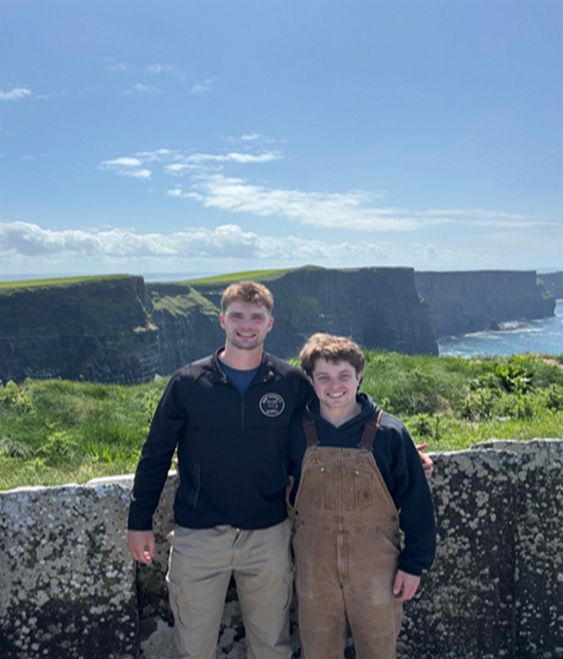
Going into the trip, my friend Will Giani had expressed his excitement about the Cliffs due to its appearance in the Harry Potter and the Half-Blood Prince movie filmed in the ocean and caves at the site. Admittedly, I had only read up to the Prisoner of Azkaban and had watched bits and parts of the movies, so I had no general clue of what to expect going into the Cliffs of Moher. Driving through the rolling hills of the Burren countryside, my excitement began to grow as we got eyes on the ocean. Pulling in, I saw a glance at the vertical drop of the rocky ledges, along with the hundreds of tourists joining us that day at the park. We parked the van and began our ascent up the walking path, looking to my left as we climbed the stairs to the main lookout of O’Brien’s Tower. 

At its highest height of 700 ft., the Cliffs of
Moher are formations composed of sandstone and shale layers that date back to 300 million years ago during the Carboniferous period. During this period the area was submerged under a warm, shallow sea, causing vast amounts of mud and sand to be deposited, creating shale and sandstone. Erosion caused by wind, rain, and the powerful seacoast sculpted the rocks into the Moher Cliffs today.

Even on a beautiful, sunny day I could still feel the austerity of the cliffs, looking into the waters below thrashing against the sandstone below. Resilience is a word that comes to mind when looking at the base of these cliffs, especially the flora along these cliffs. With constant winds and waves thrashing environments, plants need to adapt to survive conditions with high salinity and limiting nutrients.

Seabirds were not seen from atop the cliffs, but I can guarantee these cliffs serve as a nesting ground for seabirds in Ireland, safely away from ground predators and away from human disturbance. According to quick research, there are over 30,000 seabirds that are seasonal residents at the cliffs. These birds include puffins during their breeding season, from late March to early August, along with the northern wheatear and murres, which breed on the cliff tops.

The group took plenty of pictures atop the cliffs, Professor McCabe and Jack Cappiello played a few tunes on the Irish whistle, O’Brien Castle was explored, and we made our way back down the hill towards the town of Liscannor. You could see miles out into the ocean waters with the clarity of the day, the sun reflecting off the shimmering ocean surface. Straight ahead was Liscannor; turning around 180° were the rolling hills of Clare County, filled with sheep and stone stonewalls. The lush green landscapes perfectly contrasted the bright blue skies, scattered trees, and expansive stone stonewalls faded in and out of the county valleys.

Even If our time spent at the Cliffs may have been short, the experience will continue to be embedded in my memory for the near future, even after leaving Galway. Experiences like these cannot be captured through any sort of camera lens, bringing our studies of coastal ecosystems to life. Having this week of studies outside of the classroom has left an appreciation for different ecosystems outside of the New England landscape. The Cliffs of Moher will always be a reminder of my appreciation of the awe of the coastal landscape and the urgent need to protect these environments the natural world has carved into our landscape. Thank you, professors McCabe and Constantino, along with the study abroad advisors at Saint Michael’s College, for providing this experience for me and the rest of my peers in Galway, Ireland. Without your efforts, none of this would be possible.

Preston Hewett  


Friday, June 6, 2025

Galway 6: fastest animal on the planet...nearly - Olivia


              Birds of prey play important roles in not only the ecosystems of Ireland but in many ecosystems across the globe. In the Aillwee Birds of Prey Center we had the amazing opportunity to become familiar with three of the twenty-five birds, all of which have been trained in falconry.

We were first introduced to a Harris Hawk. Native to southwestern United States, this hawk was trained to fly to the location the handler designated with an incentive of meat. As I sat in the bleachers the handlers wandered around the arena and throughout the crowd letting the Harris Hawk fly between two handlers as we learned more about this species.

During one of the hawk’s flights the handler was standing behind me and the hawk flew right past my face. I could feel the wind of its wings on my nose as it landed on the handlers’ arm. The audience was allowed to volunteer as a


handler and have a brief experience of calling the hawk to their arm. Several Saint Michael’s students volunteered and were able to see the incredible relationship and trust that forms between the hawk and handler. Having such a personal experience with the hawk allowed participants to examine their features and unique coloration.

The second bird that was brought out was the Lanner Falcon. These birds are built for speed and acute eyesight. Their native environment is the African continent. Due to their incredible eyesight they are adapted to dive silently through the air towards their prey at high speeds as a surprise attack. We watched as the handler used a decoy bird to act as the prey and show this diving behavior.


The falcon dove several times as we got the narrative of this species’ story until finally the handler allowed the falcon to capture the prey. One of the most important steps in handling birds is providing the incentive once a task is complete and so the handler quickly gave the falcon its reward. As the falcon spread its wings while perched and guarded its food we could see its unique coloration as well.

When comparing the coloration of the lanner falcon and the harris hawk, as well as the final bird we saw the Red Kite, all three of their genetic makeup of variable coloration and patterns provided an example of how each species uses camouflage to blend into their varying natural habitats.

The Red Kite had a unique story and importance


to Ireland. Along with the golden eagle and white-tailed eagle, the red kite is an example of a success story of rehabilitation into Ireland’s native habitat. All three species faced extinction from the country but due to conservationist efforts these birds have been regaining stability in Ireland after being reintroduced.

Native to Ireland and up into the rural Russian Mountains, Red Kites have a low energy expense and are extremely successful hunters. The particular Kite that we were introduced to was released from the mountain side from one of the handlers in the distance and it flew down to our viewing arena, being shy at first but then becoming more friendly as the presentation came to an end.


The practice of falconry and conservation efforts have worked together to help bring awareness to the importance of birds of prey in our ecosystems. While watching the presentation I felt both this sense of awe for the abilities the birds had but also the realization that it is so rare that we take time to reflect on their presence as well as many other species. Through demonstrations such as the Aillwee experience I always walk away with a feeling of respect, particularly respect for the creatures and their specific role they unintentionally play.

As people we have an understanding of what balance means. In the world around us balance isn’t always perfect but it is necessary for the success of the survival of the ecosystem. Many of our students expressed how incredible it felt to have that one-on-one experience with the birds. I feel that this is a very important aspect in educating people on species preservation. When we can connect human emotion to the issues many of these species are facing we can encourage people to notice and care.

Many of the birds within the Aillwee Birds of Prey Center were either once injured and are in rehabilitation or were raised in an effort to increase the population and used for conservation education. Stories such as the Red Kite’s are common everywhere around the world.

In America we have our famous American Bald Eagle whose rehabilitation success story has been ingrained in our understanding of ecosystem balance. The more that we push to care about species such as the ones we learned about and interacted with, the greater our understanding can be established of the importance of biodiversity as a fundamental element to ecosystem survival.

- Olivia Record 

McCabe note: The lanner falcon is in the same genus as the peregrine falcon, often cited as the fastest animal on the planet.  From our observations, the lanner falcon is no slouch in the speed department either!

Galway 5: Three quarters of a mile underground - Travis

Today we did the Aillwee Burren Experience and I will be focusing my blog on the cave portion
of our tour there. We also experienced a bird of prey demonstration after a cave walk through. The cave is located in Burren, County Clare.

The Burren which is a rich biodiverse landscape known as Glaciokarst. The word “Glaciokarst” is broken up into two parts; the “Glacio” part refers to the landscape that has been greatly influenced by glacial activity in the past and the “Karst” part refers to the distinctive surfaces which were a result of the dissolution of soluble rocks like limestone by water.

The cave was found by a farmer who chased his dog up the side of the mountain as the dog chased a rabbit into the cave. He then later explored the cave deeper and came upon two remains of extinct European Bears. The bones are displayed in the main building and one of them dates back to being over ten thousand years old. There is also a tibia from another bear that dates back to being 4,000 years old. These bears are now extinct in Ireland due to deforestation and hunting have been extinct for over 3,000 years.

Bears used the cave to hibernate thousands of years ago. We were still able to see the hibernation pits the bears made to sleep in. It was really cool to see how big they would have been and how they used the cave. Through the cave we went through narrow passes and slopes and ramps which you had to watch out for.

Through the cave there is limestone which is over 300 million years old and is the compressed sediment of a shallow tropical ocean which is now exposed above sea level due to tectonic movement. It was amazing to see fossils packed in the walls, they were all over the cave. They were brachiopods, which is an oyster-like creature but are a more common fossil in the cave.

The cave began to form over a million years ago when melt water began to dissolve the weaker rock in the cave. A lot of water that enters the cave is rain and we could see water dripping in and throughout the cave in some waterfalls. The water that enters the cave leaves behind traces of calcite, which over thousands of years builds up and creates structures called flow stone. Their cave was filled with stalactites and stalagmites, there was a beautiful example of when they connected and it was 8,000 years old.


The cave eventually narrows to a point where the cave divers couldn’t even turn around; they had to back out. One section of cave is never used and left alone for Lesser Horseshoe Bats that use it to breed and roost. They are only 3.5cm in length and have an approximate wingspan of 20-25cm. Around their nose they have a flesh part that is shaped like a horseshoe which is how they achieved their name. The fleshy part amplifies the calls when they are searching for food using echolocation. The sound pulse they send out can help them detect the size, shape, and texture of things surrounding them.

They are a protected species so someone from the National Park and Wildlife Services surveys the population. There were roughly 115 bats in the last survey a few months ago. The population of bats is never disturbed and has increased from previous years. These bats are endangered and on the verge of extinction in many European countries which is really sad to hear. However, Ireland's programs are working hard to maintain a steady growth in their population and provide bat boxes to increase their survival. Majority of the bats have moved out of the caves in Aillwee to barns, woodlands, and bat boxes. When the temperature increases they spend less time in the cave because they don’t need to warm up anymore. The cave stays roughly fifty degrees Fahrenheit all year round, so when it's cold in the winter the bats can use the cave to warm up. In September and October they will most likely move back into the cave permanently for the wintering months.

- Travis Standerski 


     This was my first time ever being in a cave and truly experiencing the beauty of how water can cut through stone. The tube shape of the cave was breathtaking and just how old it feels is something unreal. Walking through you truly get a sense of how truly new you are in this world. Things have been happening for millions of years and you can just stumble on their beauty as the farmer did. The cave has a presence on your shoulders when you’re walking through, the low rock ceiling with fossils, water droplets, and stalagmites and stalactites all give you an ambiance that is truly a one of a kind experience.

McCabe note: During 4th class (grade) and again during a secondary school geography class, I was brought to Aillwee Caves. Since that time the route has expanded deeper into the cave and a Welsh mining company was hired to dig a tunnel parallel to the natural cave route so that visitors now have a loop to follow rather than being forced to squeeze around other groups of visitors while exiting. On this visit I couldn't help noticing algae and plants growing deep in the cave, photosynthesizing using only artificial light.

An estimated 13,000 lesser horseshoe bats occur in 6 Irish counties including Clare where Aillwee Caves are located. The caves are privately owned and the owners manage a cave section specifically for bats.