Friday, January 28, 2022

From blogging to podcasting

 Hi folks,

I have neglected my blog of late.  And so I decided to try something new: a podcast. Please visit me here. They launch biweekly. I was motivated by a couple of Saint Michael's College students who host the very successful STEM at SMC podcast.

And if you are interested in starting a podcast, it is actually a fairly simple process.  Here are the steps I followed:

Equipment: I purchased a microphone on a stand with a pop filter to minimize "plosives", or the percussive sounds generated on recordings when pronouncing "P" for example. I also got a good pair of headphones to help with both recording and editing. I have learned that by having the mic off to one side and essentially pointing at my ear, I can minimize the hisses that come when pronouncing "S" sounds.

Software: I downloaded and installed Audacity, free recording and editing software.

Hosting platform: I have used Anchor thus far and have not evaluated any other platforms.  It offers several advantages:

  • I record and post once, the Anchor platform pushes the episodes out on the biweekly schedule I established to several linked podcast sharing sites including Apple Podcasts, Google Podcasts, and Spotify.
  • RSS links are provided to put the podcast on places like IHeartRadio and Stitcher.
  • I can upload reusable components (opening, closing) and splice them onto my episodes in the platform.
  • Anchor links directly to Wordpress and with a simple click and save I can put my new episodes onto the Wordpress site.
  • It is free to use and to link with the various popular podcast hosting sites!

I had five followers on my much-neglected blog; thank you all! The podcast launched this month and the most recent episode reached more than 70 people.  I'm calling that a success!  When else do I reach 70 people? .....almost never. I have enough recorded to go until mid March and will record a few more during Spring Break.

So, if you'd like to hear some natural history in your car as you pop around from the hardware to the grocer, or as you fold the laundry, by all means give Nature Snippets a listen.

Monday, October 12, 2020


Caught on camera

Finding the wild in the city (This first appeared in The Other Paper)


Monday, January 13, 2020

If it looks like a snail....it might be a caddisfly

If it looks like a snail....it might be a caddisfly

After a year long hiatus to work on other things, I'm back to the blogosphere.  For my first foray of 2020, I present to you an article I wrote for The Outside Story in September 2019.

While sampling in the LaPlatte River, students noticed what looked like rough black pebbles about the size and shape of well-worn pencil erasers. I suppressed my mild distress as they started to discard the ‘pebbles;’ when sampling aquatic insects, I discard little.
https://upload.wikimedia.org/wikipedia/commons/3/32/Helicopsyche.png
Note black grains of magnetite. Photo by Erin Hayes Pontius 


I gathered the students around and balanced one of the pebbles on my finger and simply said “watch.” Shortly thereafter, the pebble was making its way off my fingertip seeking wetter and cooler places.

We placed several of the animals in dishes and distributed them along with hand lenses. Discoveries and observations were made on all sides. “When you see it up close, it’s obviously a snail.” “Hang on, it seems to have legs.” “It just blew a bubble out the back end.” “Hey, they pull back into the shell if you poke them.” “Somehow they stick to my forceps.”

Unplanned observations testing no particular hypothesis are essential components of field biology. The animals were snail-cased caddisflies, Helicopsyche borealis. When empty cases were first observed, a biologist described them as snails with the unique ability to incorporate sand grains into their shells.

The truth is more interesting. Caddisflies in the genus Helicopsyche bind sand grains together to make protective cases. Case making is common in caddisflies, but snail-shaped cases are unique to just one genus, at least in North America. That snails and caddisflies have evolved to produce very similar protective structures is a remarkable example of convergent evolution.

In common with snail species, Helicopsyche shells, or cases, generally coil in one direction. When Robert Hinchliffe and Richard Palmer from the University of Alberta examined 150 Helicopsyche cases from the Royal Ontario Museum collection, they found that all coiled to the right. When I look at preserved specimens in my collection, I have yet to see any coiled to the left, but now I’m inspired to look more carefully.

As my students looked carefully at their specimens, they made observations I can’t make from pickled samples; for example, the bubble that escaped from one case. Like many caddisflies, Helicopsyche larvae wriggle to create small water currents through their cases. This brings in oxygenated water and flushes away caddisfly waste. The waste produced by a single Helicopsyche must be scant indeed; but in aggregate I’m sure that their output, together with that of other species grazing on the rocks of the LaPlatte River, provides organic matter for an array of other tiny organisms that eke out their existence by gathering or filtering particles from the water.

Helicopsyche larvae eat periphyton – a blanket term that refers to the algae, diatoms, bacteria, and fungi that grow on clean rock surfaces. In some situations, the snail-shaped Helicopsyche case serves as a mobile garden. Jennifer Cavanaugh and colleagues from the University of Wisconsin discovered that larvae from one caddisfly species grazed periphyton right off the cases of their peers. It would be interesting to see if Helicopsyche cases provide similar movable feasts in the LaPlatte River.

Why the caddisfly cases stuck to students’ metal forceps proved to be the most challenging question of the afternoon. My first thought was that the caddisflies were grabbing on with their six limbs, as river insects do. My students rapidly disabused me of this simplistic notion. I was schooled when one student showed me that even when the insects were completely withdrawn into their protective armor, the cases seemed magnetically attracted to the forceps.

Magnetism proved to be the answer. After preserving some Helicopsyche cases in alcohol, and bleaching off the periphyton, the mystery was solved. The now empty cases still clung to metal. On examination under the microscope, small black grains were present among the brown and white sand grains. And when I carefully disassembled the cases, and dissected out the black grains, only the black grains were attracted to the forceps. The caddisflies had incorporated some magnetite into their cases.

We counted our caddisflies and other insects before returning them to the stream. Data sheets were filled, metrics of biodiversity calculated, and hypotheses tested; this was the planned point of the trip. But a great many more interesting lessons were learned simply by watching an insect as small as a shirt collar button. I like that it was many people looking closely and that each person noticed something different – the best part of an overall lovely afternoon, I thought.

This article was written for Northern Woodlands Magazine's Outside Story and first published on September 30th 2019  Visit the archive! The image, taken at Saint Michael's College, has been shared on Wikimedia Commons.

Declan McCabe teaches biology at Saint Michael’s College. His work with student researchers on insect communities in the Champlain Basin is funded by Vermont EPSCoR’s Grant NSF EPS Award #1556770 from the National Science Foundation.

Friday, December 7, 2018

Wildlife tracking internship; guest blog by Dana Scheffler

Figure 1. Enjoying some personal time with our educational bear skull.

Dana Scheffler

Spring 2018 internship at a not-for-profit wildlife organization

Every forest tells a story whether or not you’re listening, or smelling. Little would you know, but animals use the same trails as us to tell stories to others ranging from: finding a new mate, expressing their ovulation levels, to marking their territory. This semester I worked with, a non-profit organization dedicated to educating local communities on wildlife tracking skills. Additionally, the organization is aimed at training people in scientific protocols needed to monitor, record, and detect wildlife tracks to monitor the status of wildlife in their communities and trains all individuals from elementary school kids, to college students, and even to professional ecologists. Their training covers tracking, scent marking, identification, habitat types, and sign location. Using data from trained teams, land trusts, local boards, and agency officials are able to conserve more biologically critical habitats.
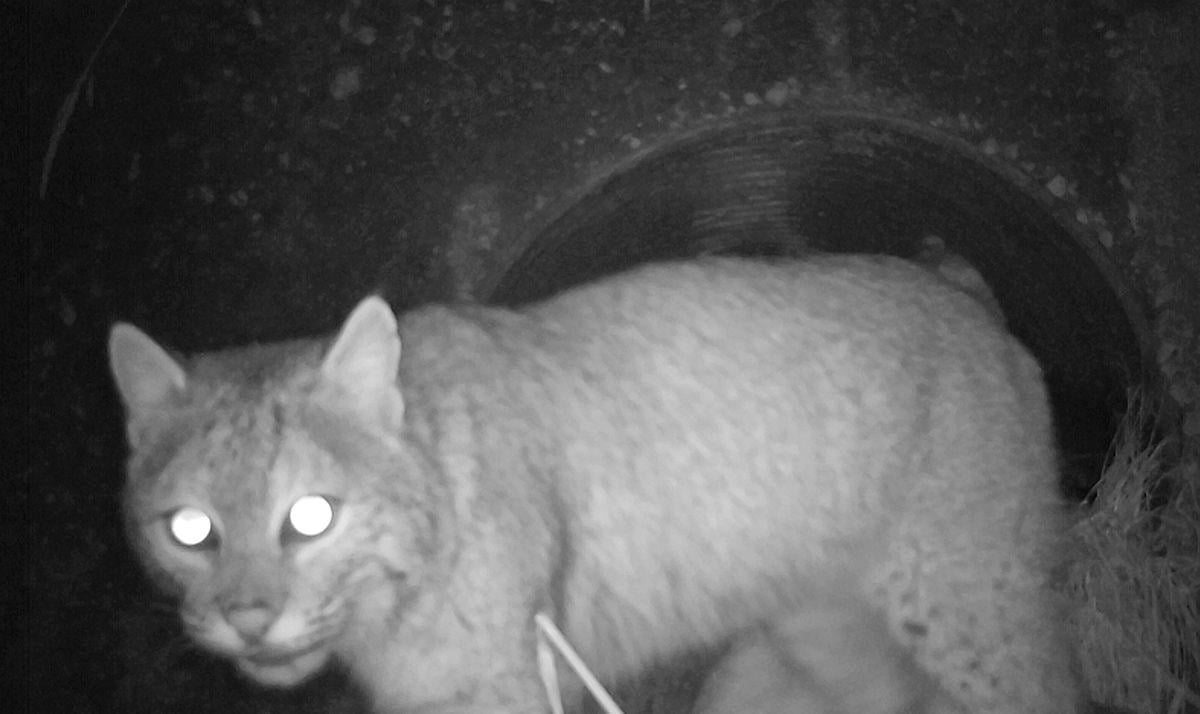
            This semester, I assisted in dictating new camera trap locations as well as serving as an assistant on training trips. Setting up camera traps helped me enhance my scent marking and tracking skills, since we would often search for repeatedly marked trees or vegetation (i.e. caves for Bobcats, absorbent leaf litter for Fisher Cats, Yellow Birch for bears). One of the most frequently visited sites was where bobcats have been recorded for the past few years.  Figures 2 and 3 give a good demonstration of a bobcat scent marking a camera on the Saint Michael's College Campus. Other forms of scent marking that bobcats will take part in will include spraying, scraping, or defecating.
            Rocky ledge locations are prime sites for scent marking since the scents can be absorbed into the rock or decaying organic material, and the overhang rock protects the scent from the elements. Within a felid’s olfactory mucosa there are some 200 million odor-detecting receptor cells, which allows these cats to detect scents for months at a time. By scent-marking, cats and other animals alike are able to leave messages/love letters all across the forest for others.
Now it is just up to us if we want to slow down and try to understand these messages and the complex relationships they make up within the forest. 

Friday, August 3, 2018

The afterlife of logs


File:Rotten Log at Red Wing Park.jpgMy three children have participated in a Four Winds Nature Institute program that recruits adult family members to lead grade-school nature learning. I have worked with several moms and dads over the years to pull together materials for hands-on lessons about communities, habitats, and the natural world. The activities usually ended with crowd-pleasing puppet shows.

During my first year in the program, in a rare moment of advance planning, I read the entire year’s program, and was glad I did: “Snags and Rotting Logs” was scheduled for November, when I anticipated most logs would be frozen or buried in snow. Regardless of frost or snow, I expected that some interesting invertebrates would have tunneled deep into the soil to wait out Vermont’s winter, leaving little more than wood for the students to dissect.


So I pushed a wheelbarrow into Winooski’s Gilbrook Nature Area in September to load up with logs for November. I poked a screwdriver through the bark of each log to confirm that wood was sufficiently rotted to host a diverse community before bagging them for cold storage. I had stacked the odds in favor of success by selecting only the ‘best’ logs: my poking and probing quickly focused my attention on birch.

The point of the Four Winds lesson is to show how snags (standing dead trees) and downed logs, while no longer growing wood, are very much alive with other organisms. Fungi that weakened trees and hastened their return to earth continue releasing enzymes and are joined by soil fungi, further breaking down cell walls. Insects and other invertebrates, incapable of digesting wood without the help of fungi and other microorganisms, draw sustenance from the decomposing debris. Carpenter ants dine elsewhere, on sweet or high-protein foods, but they nest in decaying wood.

This early invasion of dead wood sets the table for larger creatures. Shrews, moles, and insectivorous birds chow down on the abundant six-legged protein-packed morsels.  Woodpecker activity opens up the logs to the elements, accelerating the breakdown and release of nutrients from the wood to forest soil. Pileated woodpeckers are a good indicator of mature forest conditions including snags for nest sites, and logs in various states of decomposition.

For woodpeckers’ purposes and mine, not all logs are created equal.  Some, such as black locusts planted in years past to grow fence posts, take a long time to decompose and are therefore poor hosts for invertebrates. Researcher GrĂ©goire Freschet and colleagues in Holland modeled log decomposition and showed that alder, willow, and poplar lose most of their density to decomposition in eight years; logs from pine roots were far tougher lasting four times as long.  However, all of these trees share one characteristic that made them less interesting for my purposes: the bark tends to rot first.

Birch flips the decomposition process on its head.  The wood rapidly rots to crumbly pulp while the bark, protected by antifungal compounds, persists as an intact cylinder. These “birch pipes” can serve as important habitats for invertebrates. With a long bladed shovel, it’s easy to lift an intact yet very rotten birch log into a bag along with all of its inhabitants.

Birch pipes have been a great way for children in our Four Winds program to make hands-on investigations, discovering how rotting logs are essential habitats for centipedes, millipedes, sow bugs, beetle larvae, and ants as well as the birds that depend on them for food. I must come clean at this point and admit that the first time I provided logs for the classroom, I sweetened the pot by adding night crawlers. The children found the night crawlers along with other earthworms and more than a dozen invertebrate species that had not required my real-estate services.

The thrill of ‘the hunt’ through decomposing logs is a good example of how kids’ science instruction doesn’t always require fancy equipment; often all that is needed is outdoor materials and time to explore.  Through fun activities, children and adults learn together to appreciate that nature is everywhere, and that our fellow travelers are fascinating.

This year, with the delay in cold weather, it may still be warm enough to slide a shovel under a log for study.  If you do, I recommend a well-rotted birch log.

 This article was written for Northern Woodlands Magazine's Outside Story and first published on December 11th 2017  Visit the archive! The image is from Wikimedia Commons.

Declan McCabe teaches biology at Saint Michael’s College. His work with student researchers on insect communities in the Champlain Basin is funded by Vermont EPSCoR’s Grant NSF EPS Award #1556770 from the National Science Foundation.

Sunday, April 1, 2018

Ice-Out Days and Climate Change

While driving down from Isle La Motte in early December, my son and I noticed a fine skim of ice floating down the Alburg Passage. As it collided with the Route 2 bridge supports, it broke into rectangular fragments.  I wondered if what I was seeing was typical, or a symptom of changing climate? But a single observation tells you only about the current weather, and says nothing about climate trends.
To understand long-term patterns requires long-term data. So I reviewed ice formation data on Lake Champlain. I learned that between 1816 and 1916, the lake was “closed” to navigation in 96 of 100 winters. In the last 30 winters, the lake has closed 13 times, and just three times this past decade.  At first blush, this might seem like overwhelming evidence for less ice, but again, this is not the whole story.

 The 200-year data set was gathered by three different governmental agencies, a Burlington public official and historian, and a “cooperative weather observer.”  Consistency might be a bit much to expect and “closed to navigation” could range from an ice passage from Burlington to Plattsburgh, or simply frozen harbors.

For a more consistently measured data set, Dr. Alan Betts, a Vermont climatologist, looked to the Joe’s Pond Association. Each winter for more than two decades, association members have placed a wooden pallet on the ice of Joe’s Pond in West Danville, Vermont. A cinderblock sits on the pallet and is strung to the plug of an electric clock on Homer Fitts' deck. For a small donation to the association, you too can guess when the ice will give way, the cinderblock sink, and the clock be unplugged; best guess wins!
Ice-Out Days and Climate Change Image
Stiles Pond Ice-Out Dates and Frozen Days,
updated to Spring 2017, courtesy of Dr. Alan Betts

The simplicity and consistency of this measurement technique is precisely what peaked Betts’ interest.  Across the short interval of twenty years, there’s a clear trend; the cinderblock sinks about 6 days earlier than it did two decades ago.
Betts has also reviewed 40 years of ice-out data from the Fairbanks Museum and found the same pattern: the ice on Stiles Pond goes out about three days earlier per decade. Every decade, on average, the pond has frozen four days later, and the total frozen period has been shrinking by seven days per decade since 1970.

 “Ice out” patterns are consistent with other indicators of change. For example, Betts has reviewed data on Vermont’s lilac flowering dates. On average, lilac leaves are developing about two weeks earlier than they did in the 1960s, and flowers open more than a week earlier.

With the greatest respect to ice and lilac, I suspect that some Vermonters might be more interested in changes in maple sugaring; this thought has not been wasted on Vermont scientists.  Justin Guilbert and Vermont EPSCoR collaborators examined climate trends and predicted 11 fewer maple sugaring days by mid-century. They also predicted a shift in the sugaring season towards the midwinter months of December and January.

If at this point, you’re thinking that these trends are awfully short-term, and that anyone trying to predict the future of sugaring is walking on thin ice, you have a valid point; one of the difficulties of predicting climate change and its effects is the complexity of factors, including the background “noise” of our naturally variable weather conditions. This is, after all, a region which prides itself on the notion that, “if you don’t like the weather, wait a few minutes.”

That said, while we can’t with certainty predict what maple trees, or ponds, or ornamental plants will do in future years, it’s very clear that we’re in a period of rapid temperature change, and based on what we know of atmospheric science and human-caused emissions, there’s no reason to expect that change to stop any time soon.

As Betts recently told me, “climate change is on a roll and all we can do is slow it down, and give our societies and all of life on Earth more time to adapt.” In the meantime, I plan on placing my first ever bet on Joe’s Pond this year.  What day I will bet on?  That’s my secret; but it will certainly be earlier than I would have bet in 1997.

 This article was written for Northern Woodlands Magazine's Outside Story and first published on February 5th 2018.  Visit the archive!

Declan McCabe teaches biology at Saint Michael’s College. His work with student researchers on insect communities in the Champlain Basin is funded by Vermont EPSCoR’s Grant NSF EPS Award #1556770 from the National Science Foundation.

Download the Article

Saturday, February 17, 2018

Underwater assassins

Ranatra linearis, a first cousin of Vermont water
scorpions.  Image from Wikimedia Commons.
Recently my daughter participated in Odyssey of the Mind, a creative problem solving competition devoted to ingenuity and team work. As an entomologist, I was thrilled to learn that the program calls its highest award the Ranatra fusca. Not only was the award named for an insect, but an aquatic insect, and a particularly fascinating one to boot.

Ranatra fusca is the Latin name for a water scorpion, a creature little known to the general public but familiar to those of us who wield nets in ponds. This insect bears only a passing resemblance to real scorpions (which are arachnids, not insects). It does sport what looks like a prominent tail (more about that later), but lacks any sort of stinger. It can, however, be quite lethal…if you happen to be an aquatic insect, tadpole, or even a small fish.

Humans have nothing to fear from water scorpions. Unlike their larger cousins, the giant water bugs known as “toe biters,” water scorpions are not known for biting on toes or other human parts. Besides, they live in tall weeds where entanglement would be a far greater health hazard than insect nibbles.

Despite measuring in at more than three inches, these amazing predators are easily overlooked by casual observers, and by their prey. They combine stealth with uncanny camouflage. They hold their long, stick-like, brown bodies parallel to the vertical stalks of plants and can remain perfectly still while breathing through a snorkel.

Unlike the snorkel I use when observing aquatic insects, water scorpion snorkels sprout from their rear ends. This is what looks like a tail, and inspired their common name. Rather than a single tube, a water scorpion snorkel consists of two half cylinders held tightly together to create an airtight pathway (at the insect’s death, these often separate). The snorkel conveys air to spiracles, or breathing holes, on the abdomen.

The snorkel is impressive enough, but the water scorpion has another breathing trick in its repertoire. Once air reaches the spiracles, water repellent hairs trap it within a bubble. What this means is that the water scorpion has an on-demand scuba tank. When fully submerged below the water’s surface, it can still breathe from this reserve of air.

But wait, there’s more. When winter ice blocks access to the surface, the bubble switches function from a scuba tank to a gill. Oxygen from the water diffuses continually from the water into the bubble. The water scorpion can survive on this diminished air supply, aided by a dramatic reduction in metabolic rate as the temperature drops.

Thanks to these adaptions, water scorpions can wait for long periods until their next meal swims by. Then they give a nightmare performance of the old AT&T slogan “reach out and touch someone.” Long raptorial front legs whip out like jackknives and firmly snatch the hapless prey right out of the water column. Things just get more fiendish from there.

Actual scorpions use their claws to quickly tear up their prey and thrust the fragments between their jaws. As painful as that may sound, death by water scorpion is a worse way to go – a drawn out and gruesome affair. The insects skewer their prey with a pointed mouthpart and suck out their fluids as if through some sort of barbaric drinking straw.  At the end of the meal, all that’s left is an empty husk.

When my colleague Scott Lewins takes his Saint Michael’s College students out for their first day of insect collecting to Gil Brook in Winooski, water scorpions are high on the list of coveted specimens. For the budding entomologist, what could be cooler than a large insect that looks like a stick, preserves very well, and is easy to identify? We have specimens in our teaching collection that date to the 1990s with their spindly limbs and separated breathing tubes still intact.

Back on land, it was gratifying to see the excitement on my daughter’s face and on the faces of her teammates when, after three years of competition, they received the Ranatra fusca award. An insect with Swiss army knife appendages, scuba gear, and camouflage is the embodiment of out-of-the-box thinking.

This article was written for Northern Woodlands Magazine's Outside Story and first published on November 21st 2016.  Visit the archive!

Declan McCabe teaches biology at Saint Michael’s College. His work with student researchers on insect communities in the Champlain Basin is funded by Vermont EPSCoR’s Grant NSF EPS Award #1556770 from the National Science Foundation.
Download the Article